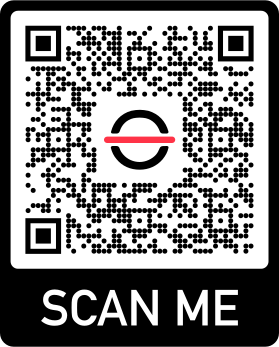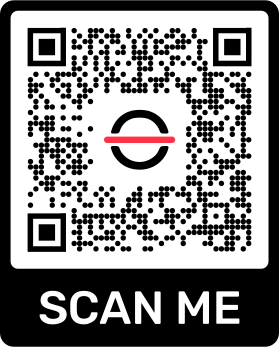

For optimal barcode detection, the majority of decoders in the market rely on the three finder patterns prescribed by the QR standard specification. This includes:
Positioning Markers: The finder pattern consists of three square markers, often referred to as squares or modules. These square markers are positioned at the corners of each QR code.
Alignment: The three square markers are arranged to form a larger square, helping the QR code reader identify the code's orientation and perspective. This alignment is crucial for accurate QR Code recognition.
Quiet Zone: Quiet Zone: The QR code's finder pattern is surrounded by a quiet zone or margin, which is an empty space with no data. This allows a QR code reader to distinguish the code from its surroundings and helps prevent misinterpretation.
The presence of the finder pattern in a QR code makes it easily detectable by image-processing algorithms used in QR code readers. Once the finder pattern is identified, the QR code reader can then proceed to decode the information contained within the code. The finder pattern specification is part of the overall QR code standard, which ensures interoperability and uniformity in QR code usage.